
Last updated November 25, 2026
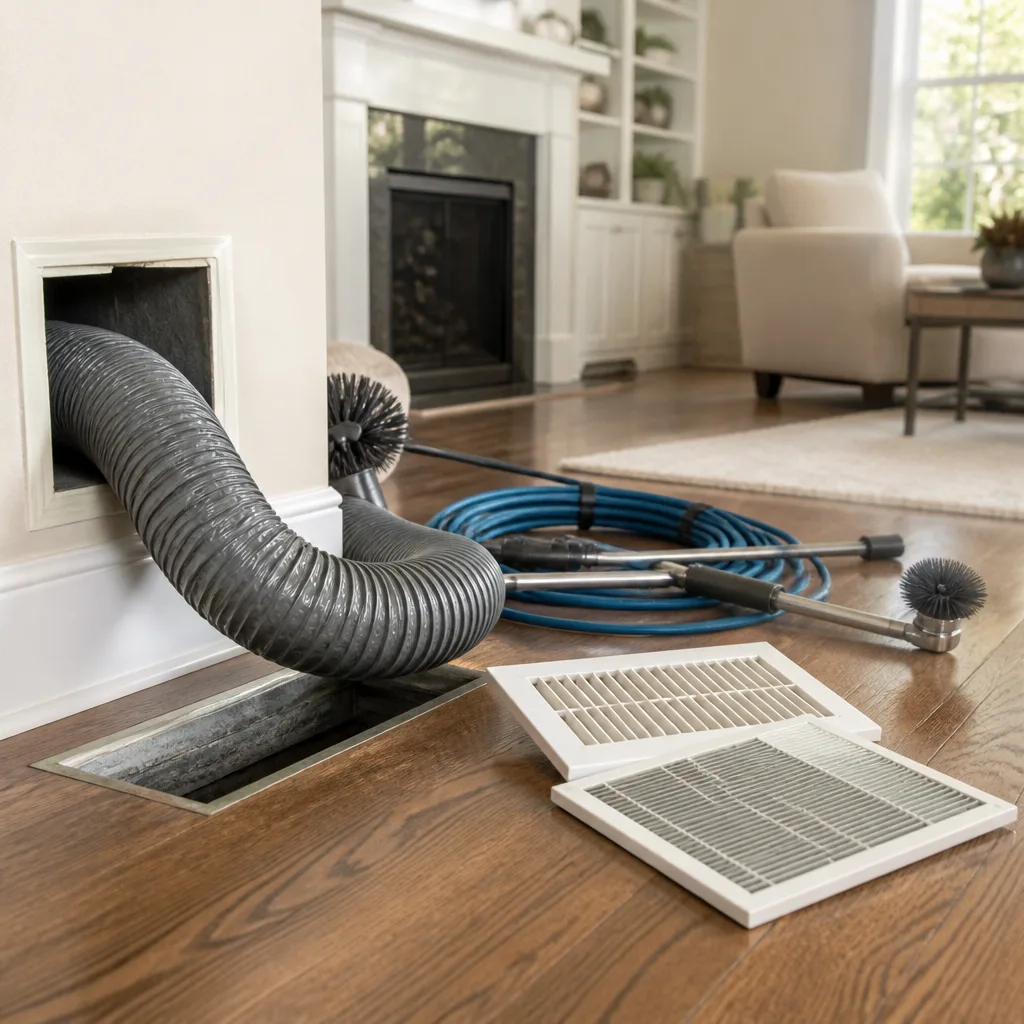 Whole-home duct cleaning
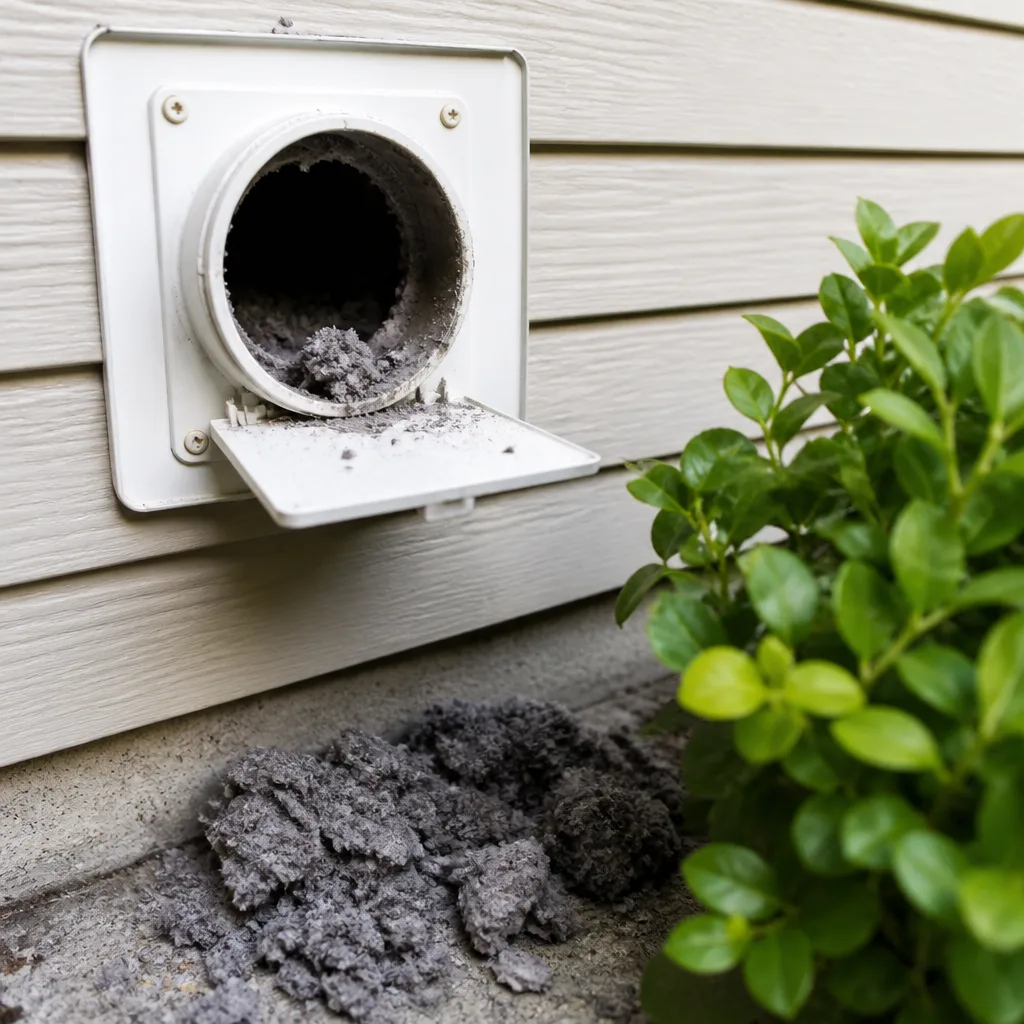 Dryer vent cleaning
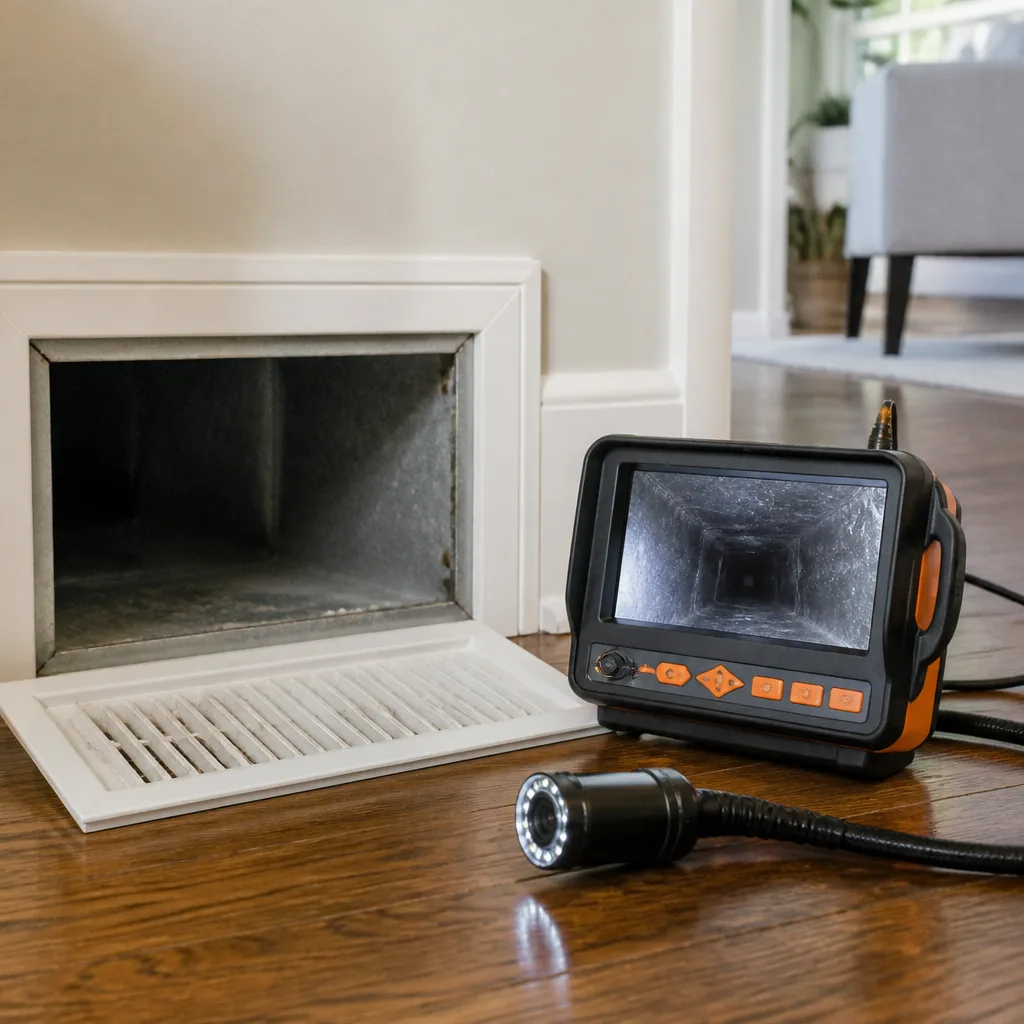 Camera inspection
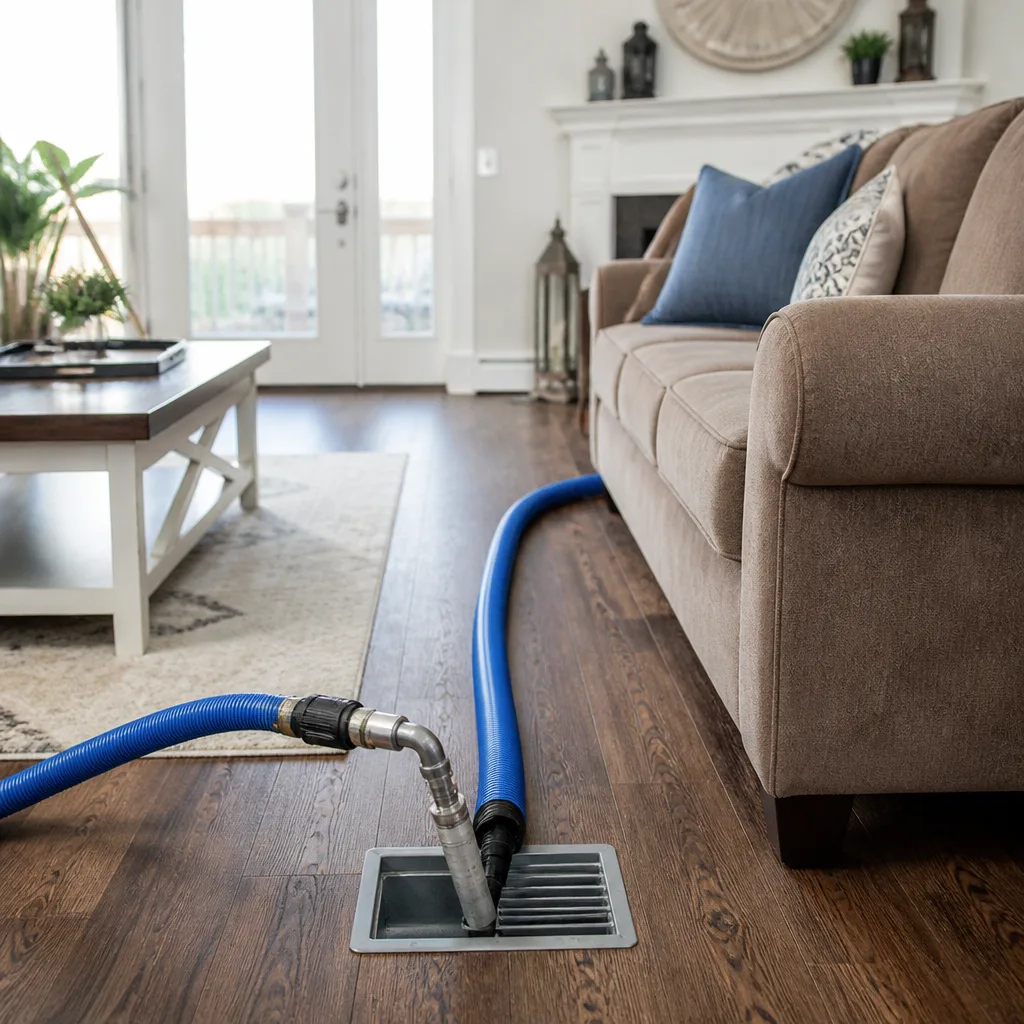 Sanitizing & deodorizing
Whole-system duct and dryer vent check with before-and-after photos - you see exactly what came out of your vents
That "$99 whole-house special" is a bait ad - the real number appears once they are in your hallway, or the "clean" is a shop-vac at the register. We photograph the inside of your ducts before and after instead.
The Complete Guide to Air Duct Cleaning in Memorial
Most homeowners who hire an HVAC generalist for duct work end up with surface vacuuming. The microbial load clinging to the sheet metal and flex liner never gets touched, because the equipment on site never pulls the system into negative pressure. That’s not a knock on generalists. It’s a mechanical fact: contact wipe-downs reach what a wand can see, and nothing else. In Memorial, where Gulf Coast humidity sits above 75% relative humidity for much of the year, that gap matters more than in dry climates. This guide maps what actually accumulates in Memorial ductwork, what real source-removal looks like from inspection to final video verification, and how to tell the difference before you write a check.
Quick Answer
Air duct cleaning in Memorial removes accumulated dust, biological growth, and construction debris from the entire duct system using high-negative-pressure extraction combined with mechanical agitation, not surface vacuuming. In this climate, that generally means addressing biofilm inside flex runs, debris in under-slab return plenums on older slab-on-grade homes, and the leaks that let all of it back in. The job is done correctly when pre- and post-cleaning video inspection of the main trunk lines shows a measurable difference.
Styles & brands we work with
- Whole-home duct cleaning
- Dryer vent cleaning
- Camera inspection
- Sanitizing & deodorizing
Table of Contents
- Why Memorial’s Humidity Changes the Whole Equation
- Source Removal vs. Surface Vacuuming: The Mechanical Difference
- Slab Foundations and Under-Slab Return Plenums
- What a Legitimate Pre- and Post-Cleaning Inspection Looks Like
- How Often Ducts Really Need Cleaning
- The Full Cleaning Process, Step by Step
- Sanitizing, Filtration, and Duct Sealing
- How to Vet a Duct Cleaning Company in Memorial
Why Memorial’s Humidity Changes the Whole Equation
Memorial sits in a stretch of Texas where relative humidity averages north of 75% for much of the year. If you’ve read a duct cleaning guide written for Phoenix or Denver, set it aside. The contamination profile here is different, and it’s driven by moisture.
Dust alone is a nuisance. Dust plus sustained humidity is a growth medium. Inside flex duct, the plastic liner stays slightly cooler than the air moving through it during cooling season, and that temperature differential is enough to condense a thin film of moisture on the interior wall. Once that film is there, dust settles into it and microbial growth follows. Biofilm binds to the liner in a way loose dust never does. It doesn’t release when air moves past it. It has to be mechanically broken up.
That’s why a shop-vac approach underperforms so badly in Memorial. You can pull loose dust out of a system with modest suction. You cannot remove adhered biofilm without agitation at the surface. This is the core reason professional equipment like the Rotobrush system exists: a rotating brush whip travels the length of the run, scouring the liner while negative pressure carries the loosened material out. Surface-level cleaning looks fine from the vent. The liner underneath stays colonized.
We’ve seen this pattern across Memorial’s older neighborhoods where systems have run for years without a real cleaning. The visible vents look acceptable. The trunk lines tell a different story. What’s inside your ducts matters more than what your vents look like from the outside.
Source Removal vs. Surface Vacuuming: The Mechanical Difference
Source-removal cleaning is the NADCA-recognized method for duct cleaning: put the entire duct system under continuous negative pressure while mechanically agitating every interior surface, so loosened contaminants are captured at the source and never re-enter the living space. Contact vacuuming is the alternative, and it’s what most generalist crews do.
Here’s the mechanical distinction, plainly:
- Negative pressure: A source-removal setup uses a high-volume extraction unit connected to the main trunk, holding the whole system under vacuum for the duration of the job. A contact vacuum pulls from a wand at one point at a time, with nothing holding the system as a whole.
- Agitation: Source removal uses rotating brush whips and air snakes that travel the full length of each run. Contact vacuuming relies on whichever surfaces a wand can physically reach through a register opening.
- Capture: With the system under vacuum, loosened material leaves the duct rather than settling back onto the liner behind the brush.
- Coverage: Source removal addresses branches, returns, plenum, and trunk. Contact vacuuming typically addresses only what’s visible from each register.
The equipment matters. Rotobrush and Nikro systems are built for exactly this sequence: brush agitation at the liner surface, simultaneous extraction under negative pressure, and HEPA-level filtration on the exhaust so nothing escapes into the room. These same platforms are standard in commercial duct cleaning work. That’s what we mean by industrial-grade equipment at residential scope. We only do this, which is why the tools aren’t a compromise between duct work and three other trades.
Slab Foundations and Under-Slab Return Plenums
A lot of Memorial’s housing stock is slab-on-grade, and a fair share of the older homes route return air through plenums cast into or running beneath the slab. This is a construction pattern that shapes how contamination enters the system, and it’s almost never addressed in general duct cleaning content.
Under-slab return plenums are typically lined or formed in a way that accumulates debris over the life of the home. Because the return side operates at slight negative pressure, anything that finds a path into that plenum gets drawn into the air handler and pushed back into the living space through the supply runs. Entry points include:
- Failed seals where the plenum meets the slab or the air handler cabinet
- Degraded duct board or liner inside the plenum itself
- Gaps around penetrations, including plumbing and wiring chases adjacent to the return path
- Cracked or poorly sealed trunk connections in the attic portion of the system
Cleaning the supply runs without addressing the return plenum and the leaks feeding it does half a job. That’s the argument for combining cleaning with duct repair and sealing under one roof: we can identify the entry points and close them in the same visit, rather than leaving you to schedule a second contractor to finish the work.
If your Memorial home dates from the mid-century building waves, ask specifically whether the return plenum is part of the cleaning scope. It’s one of the first questions we ask when scoping a job.
What a Legitimate Pre- and Post-Cleaning Inspection Looks Like
An inspection is not a look through a floor register with a flashlight. It’s a documented, video-based record of the system’s interior condition, taken before any work starts and again after cleaning is complete. If a company can’t show you the inside of your trunk lines before and after, they can’t show you that anything happened.
Here’s what a real inspection includes:
- Access points opened: The technician creates or opens access ports at the plenum, main trunk, and key branch junctions so the camera can reach the actual duct interior.
- Video documentation of the trunk lines: A camera travels the main runs, recording the interior surface. Debris depth, liner condition, biofilm presence, and any damage are all captured on video.
- Return side reviewed separately: The return plenum and any under-slab component get their own inspection pass.
- Pre-cleaning video shown to you: You see what’s there before the work begins, with the technician walking you through what the footage shows.
- Post-cleaning video of the same runs: After extraction, the same runs are re-recorded, showing the cleaned liner.
- Access points sealed: Ports are properly closed and sealed so they don’t become new leak points.
- Before-and-after photos shared with you: You keep the record of your own system.
Steps four and five are the ones that separate a real clean from a sales visit. When a company shows you before-and-after footage of your own ducts, the question of whether the work was done answers itself.
How Often Ducts Really Need Cleaning
There is no fixed interval. The EPA has not established a general recommendation for how often residential ducts should be cleaned, and NADCA’s position is condition-based: clean when inspection, contamination, or a specific trigger justifies it, not on a calendar. The common “every year” pitch is a business model, not a standard.
That matters in Memorial because the triggers here look different from a dry climate. Practical cleaning triggers include:
- Visible debris or growth inside the ducts during inspection
- Persistent dust on surfaces shortly after cleaning the house
- Recent renovation, which sends drywall dust and construction debris into open returns
- A new HVAC installation, where construction debris needs clearing from the system
- Water intrusion or elevated indoor humidity that has reached the duct interior
- Allergy or respiratory symptoms that track with time spent in the home
- A rodent or insect issue that has left contamination behind
Our approach is inspection-based: we look, then tell you what the footage supports. Some homes need cleaning every few years. Some go considerably longer. A company that quotes a fixed annual interval before looking at your system is guessing.
The Full Cleaning Process, Step by Step
This is the standard sequence for a source-removal cleaning in a Memorial home. It’s the order that produces a measurably cleaner system rather than a swept one.
- Pre-inspection and video documentation. Access is opened, trunk and return runs are recorded, and the footage is reviewed with you before any cleaning starts.
- System setup. A high-volume negative-pressure extraction unit, typically an Abatement Technologies or equivalent setup, is connected to the main trunk and the system is sealed down so vacuum holds throughout the cleaning.
- Agitation of every run. Brush whips and air tools from a Rotobrush or Nikro system travel each supply and return run, breaking contaminated material off the liner surface.
- Extraction under continuous vacuum. Loosened material is pulled out of the system while the ducts stay under negative pressure. Exhaust is HEPA-filtered.
- Return-side and plenum cleaning. Returns, plenum, and the air handler cabinet are cleaned separately, since these collect the heaviest load.
- Post-cleaning video verification. The same runs are re-recorded and shown to you.
- Sealing and repair if needed. Leaks found during the job are sealed while access is open.
- Filtration recommendation. If a filter upgrade makes sense after cleaning, we’ll recommend a Honeywell or Aprilaire filter matched to your system and your air quality goals.
Dryer vent cleaning is typically folded into the same visit, because a lint-clogged dryer vent is a fire-safety issue and usually lives within feet of the air handler closet. Most duct-only companies skip that or outsource it.
Sanitizing, Filtration, and Duct Sealing
Cleaning removes debris. Sanitizing addresses what remains on the surface: microbial growth that survives scrubbing because it’s embedded in liner pores. In a humid climate, this step is not optional fussiness; the moisture that fed the growth in the first place stays in the air.
We use Abatement Technologies filtration equipment for sanitizing work. That’s the same class of equipment used in remediation settings, which is the standard we hold this work to. The process does not substitute for cleaning, and it doesn’t replace the mechanics of negative pressure. It comes after the cleaning, as a treatment on a cleaned surface.
Filtration is the third piece. After cleaning and sanitizing, a properly matched filter helps keep the system cleaner for longer. Honeywell and Aprilaire filters, chosen to fit the system’s airflow requirements, make a meaningful difference to what accumulates over the next several years. A filter that’s too restrictive causes problems of its own, so matching the filter to the system matters as much as the filter’s rating.
Duct sealing closes leaks the cleaning just exposed. In an older Memorial home, the supply and return runs may have joints and connections that have loosened over time. Sealing recaptures conditioned air that would otherwise be lost, and it closes the paths that let outside air in.
How to Vet a Duct Cleaning Company in Memorial
A legitimate duct cleaning company will show you the interior of your system before and after cleaning, document the process, and quote a per-system price rather than a low per-vent price that inflates once the technician is on site.
Ask these questions before you book:
- What equipment do you use? If the answer isn’t a named professional platform (Rotobrush, Nikro, or equivalent), ask for details. A shop-vac-style setup isn’t going to remove adhered contamination.
- Will you show me the inside of my ducts on video? Pre- and post-cleaning video is the single best proof of work done.
- Is the price per system or per vent? Per-vent pricing is how a low quote becomes a big invoice. Ask for a flat price per system, agreed before work starts.
- Is sanitizing included, or extra? Ask what the service actually covers, then compare total figures.
- Do you repair and seal leaks? If the answer is no, expect to schedule a second contractor for sealing.
- Is the local pro licensed and insured as the state requires? Confirm this before the day of the job.
One flat price per system, agreed in writing before work starts, is our standard. You’ll also get before-and-after photos of your own system and a satisfaction guarantee behind the work. For the full range of what we handle, including duct cleaning specific to this area, see air duct cleaning.
Common Mistakes to Avoid
- Booking a per-vent price and assuming it’s the total. In Memorial’s housing stock, systems have very different run counts. A per-vent quote turns into a moving target once the technician counts your vents. Ask for a per-system flat price.
- Skipping the return plenum. Cleaning supply runs without addressing the return is a half-clean, especially in older slab-on-grade homes where the plenum carries the heaviest contamination load.
- Not asking for video proof. A company that can’t show you the inside of your ducts before and after cleaning cannot show you what happened. Skip the “before you look, we’ll just get started” pitch.
- Sanitizing without cleaning first. Sanitizer on a contaminated surface doesn’t reach the contamination. Cleaning with professional extraction equipment has to come first, or the treatment is cosmetic.
- Ignoring leaks after the clean. If the leaks that let contamination in aren’t sealed, the system re-contaminates faster than you’d expect, in a climate that keeps the liner moist.
- Accepting a “clean every year” schedule as standard. The EPA hasn’t set a general interval, and NADCA’s position is condition-based. An annual pitch before any inspection is a sales pattern, not a technical recommendation.
- Skipping the dryer vent. Lint buildup in the dryer vent is a fire hazard. When the duct crew is already on site, this is the cheapest time to have it done.
See the difference
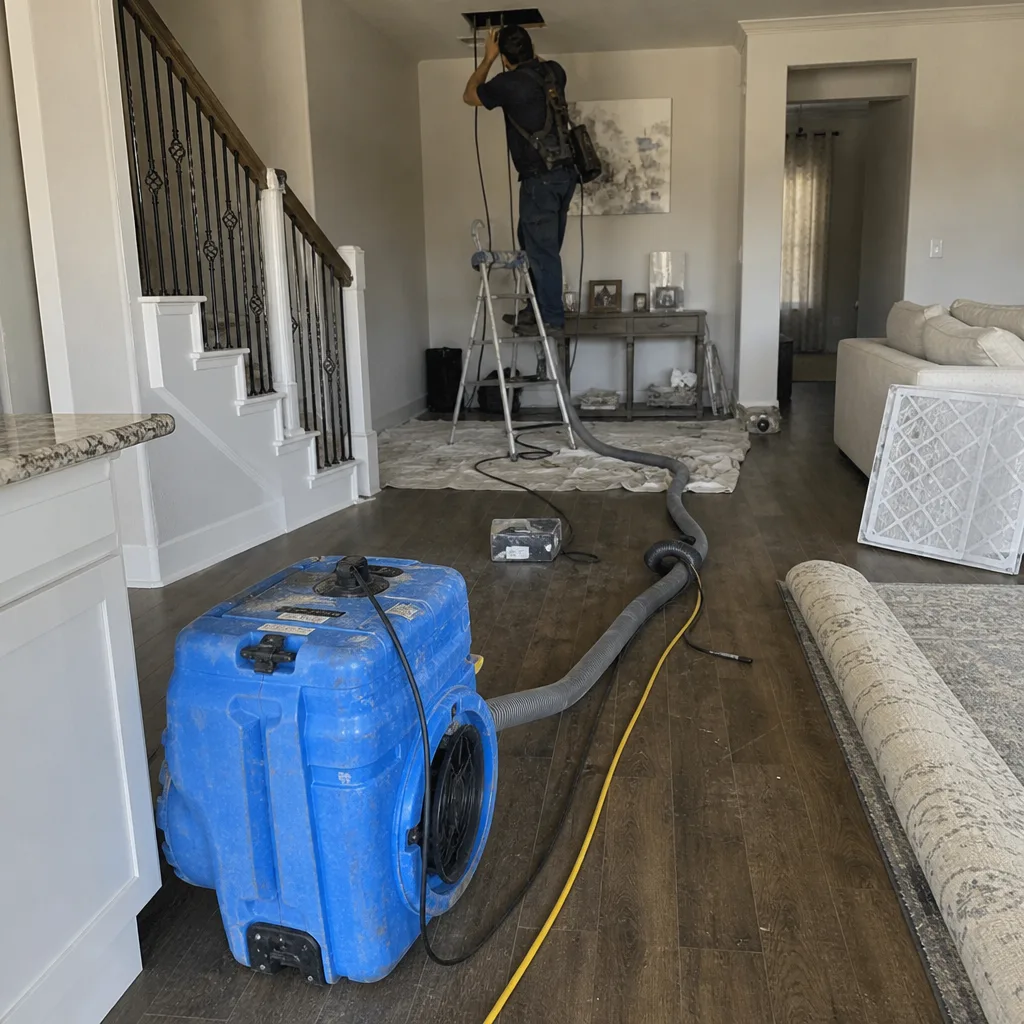 Before
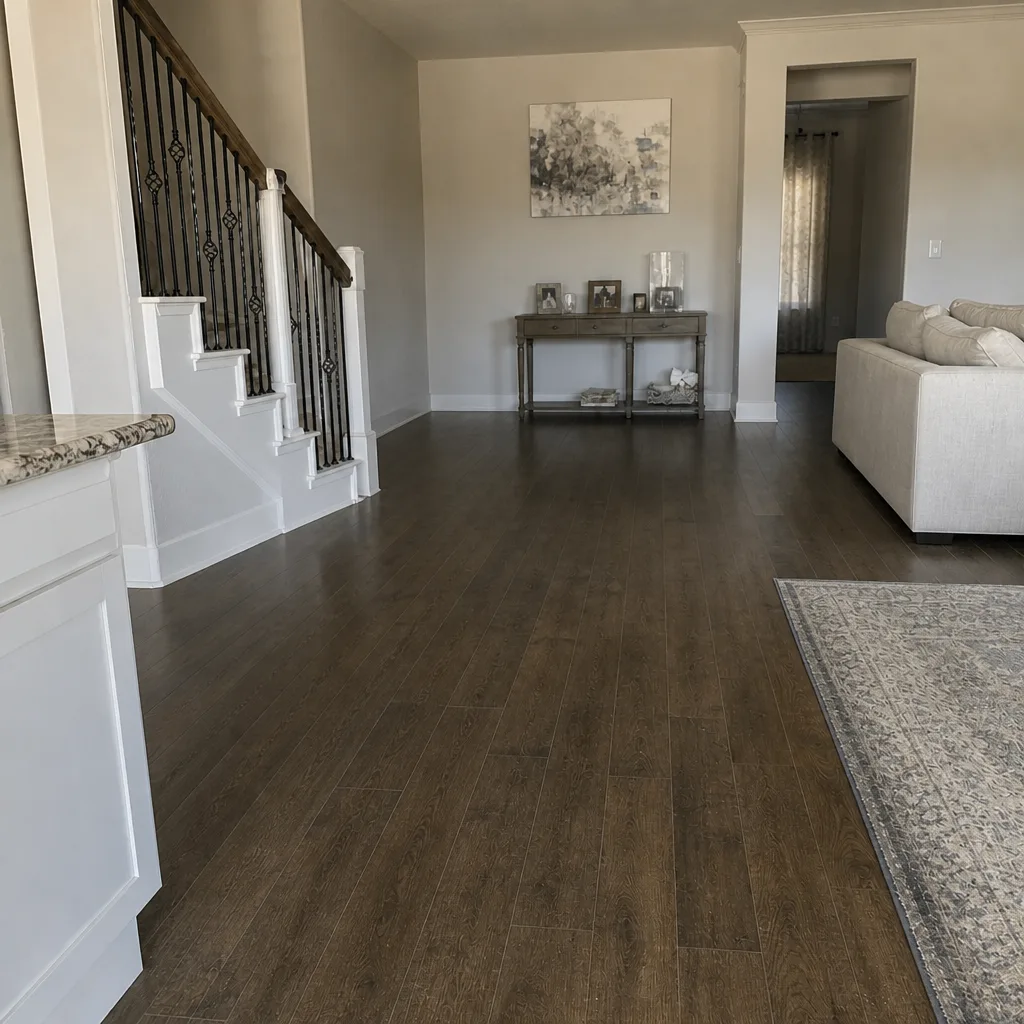 After
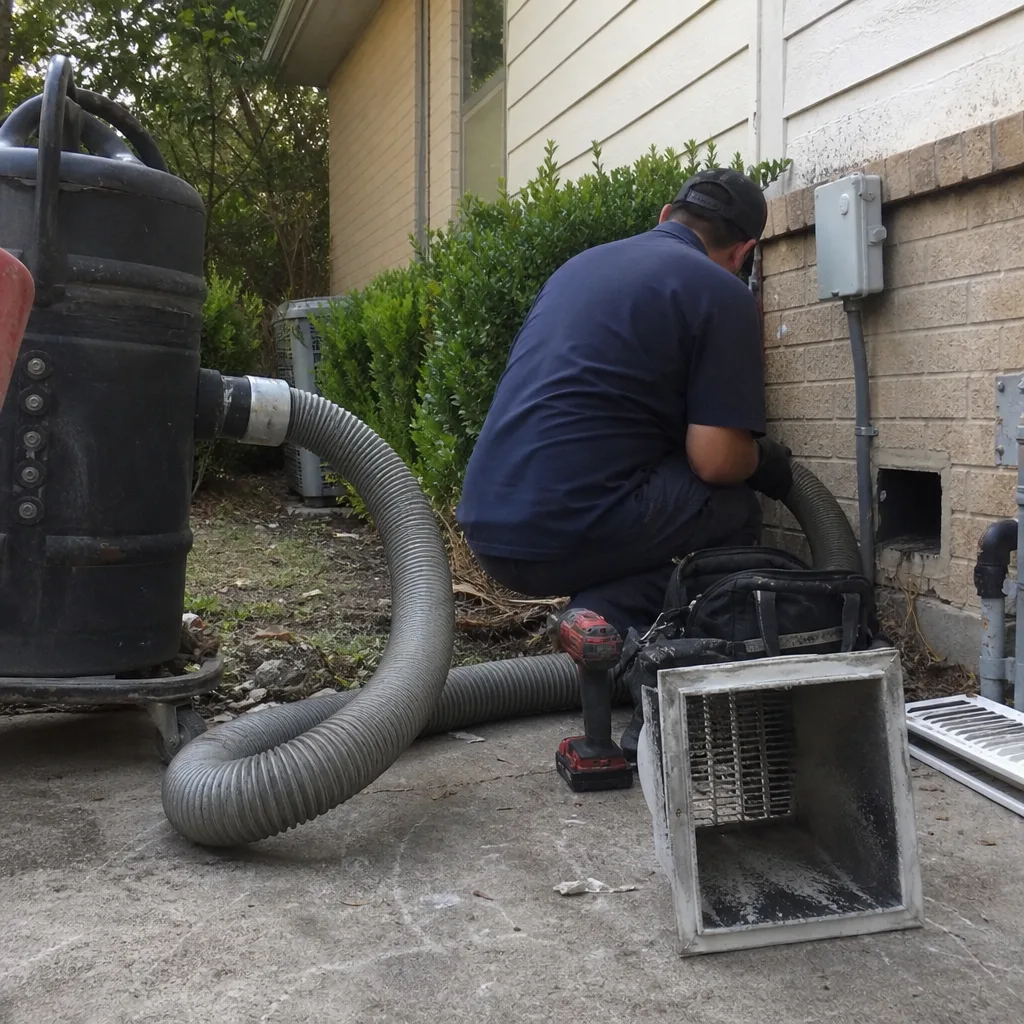 Before
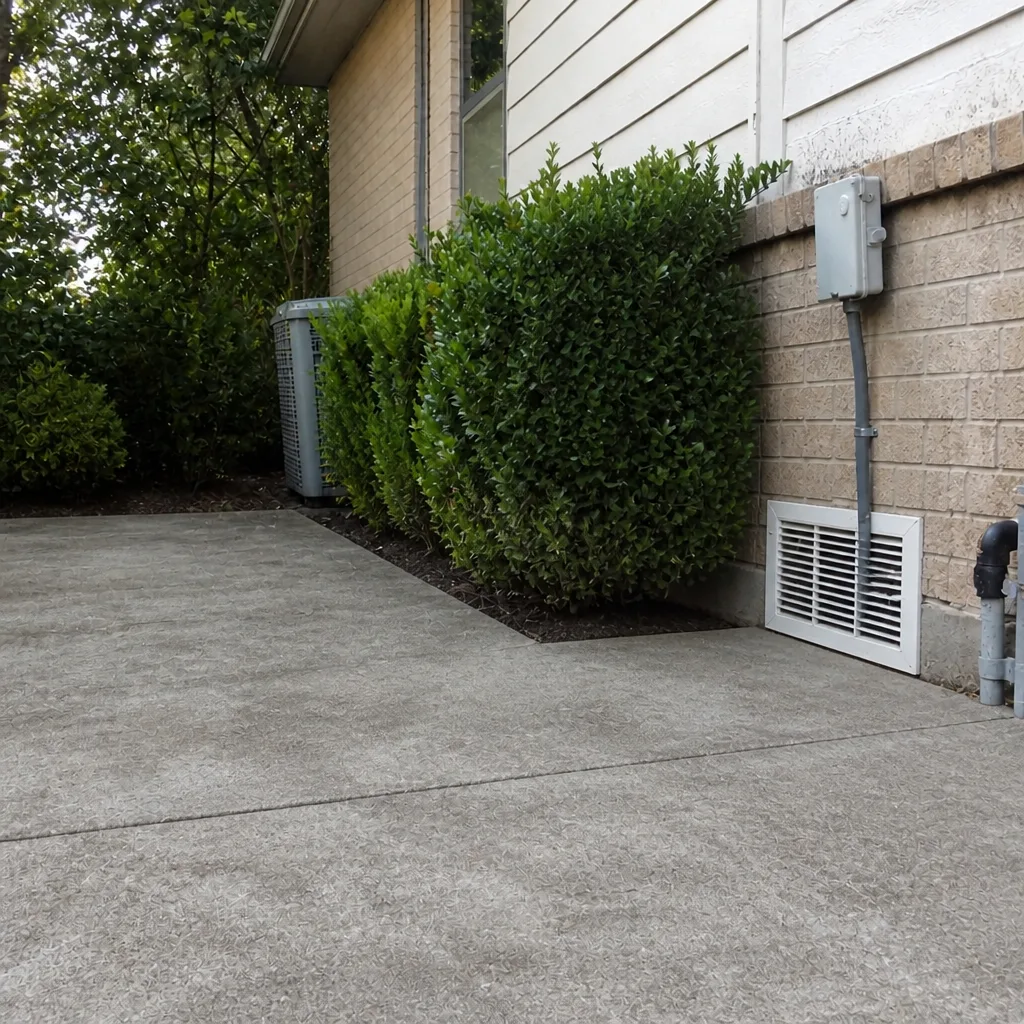 After
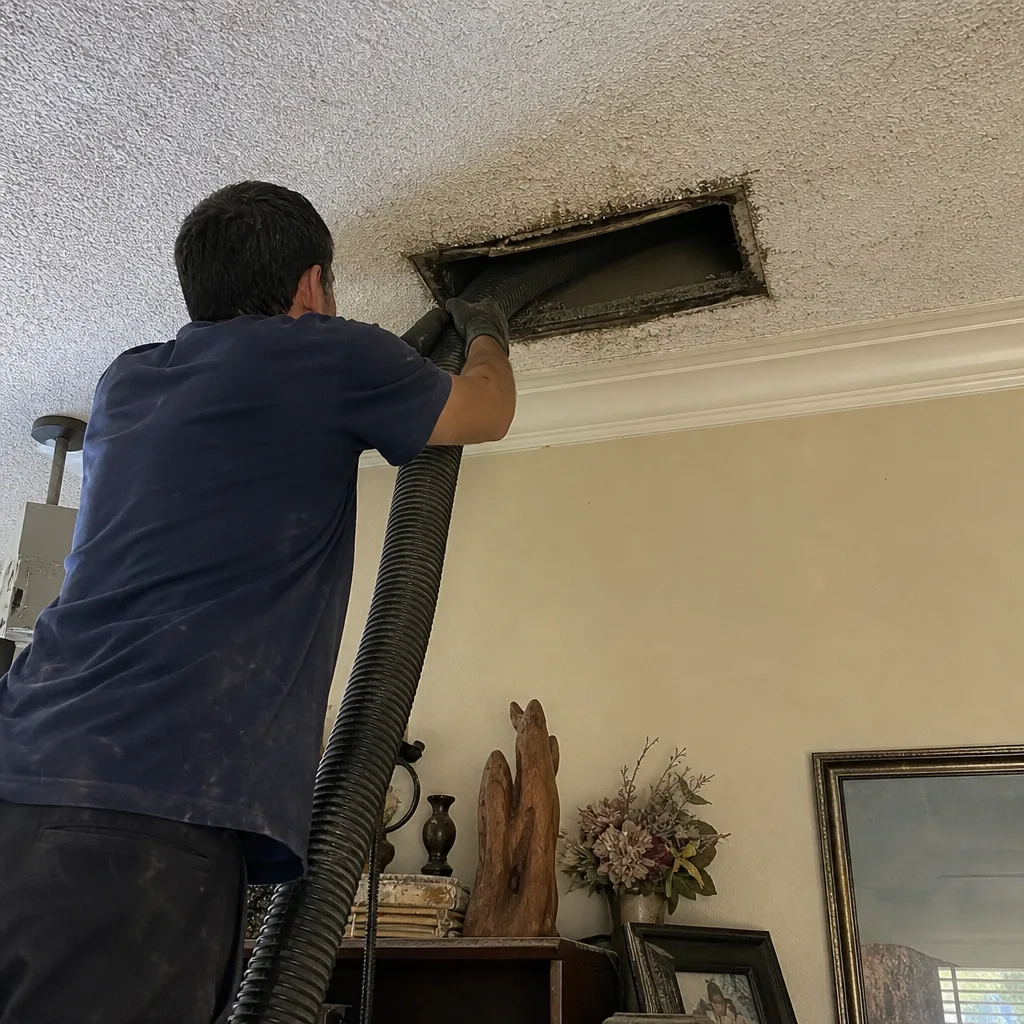 Before
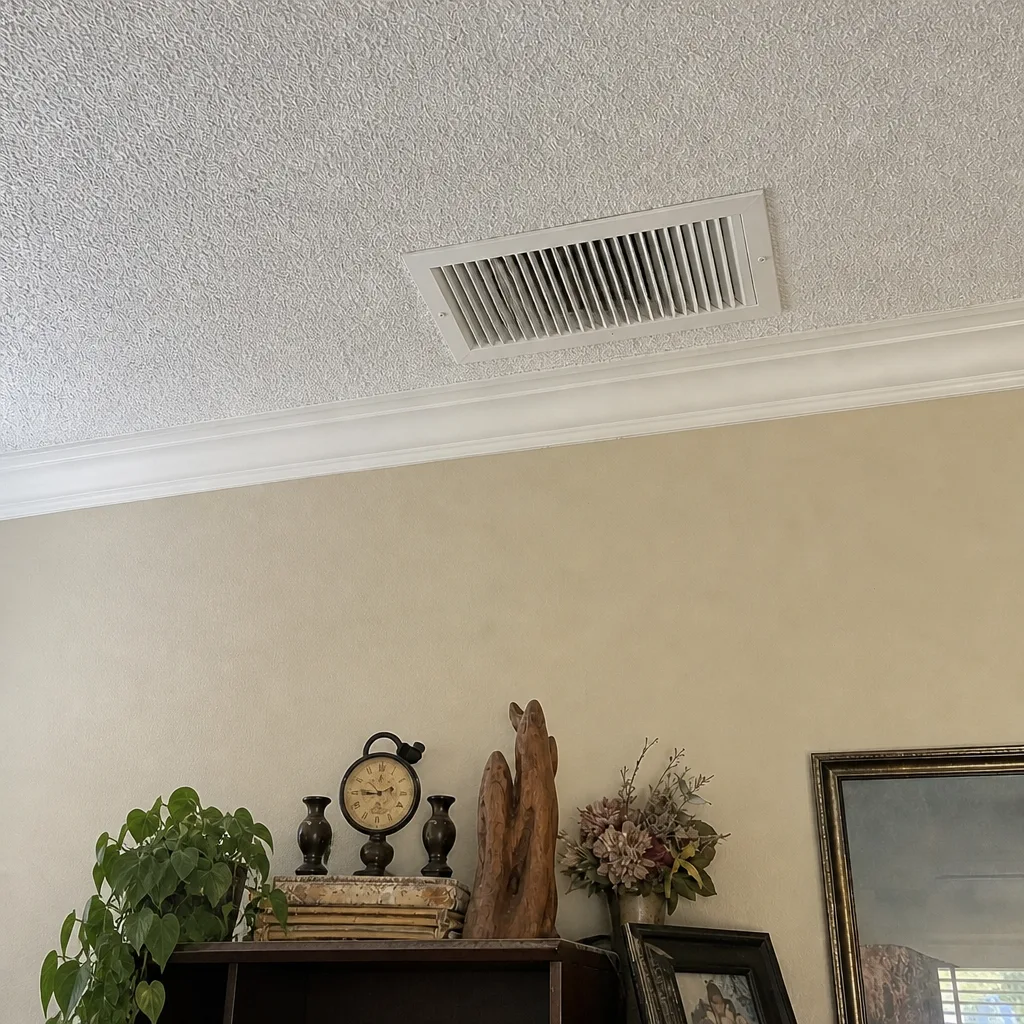 After
When to Call a Professional
Call a professional if you’ve just finished a renovation that opened walls or ceilings, if a new HVAC system was installed and construction debris went into the ductwork, or if persistent dust keeps returning to surfaces within days of cleaning the house. Also call if there’s been any water intrusion or a rodent issue that reached the ductwork. If anyone in the household has allergy or respiratory symptoms that track with time spent inside, an inspection is worth having before assuming it’s something else. And if it’s simply been many years without a look inside the ducts, an inspection tells you whether cleaning is actually justified. Air Duct Cleaning Memorial offers free estimates in Memorial – call (833) 468-3620.
Frequently Asked Questions
Fair costs are quoted per system, not per vent, and any legitimate number is a range set by the written estimate after an inspection. Quotes are free, and the estimate you get in writing is the price you pay. Call (833) 468-3620 for an exact quote – estimates are free.
Low quotes typically come from a per-vent price that grows as the technician counts vents, or from a service that pulls loose dust without agitation equipment. Surface vacuuming is cheaper because it’s less work. If the contaminant is adhered to the liner (which it usually is in this climate), the cheaper quote leaves it there. Call (833) 468-3620 for an exact quote – estimates are free.
Before-and-after video of your own trunk lines, recorded from inside the ducts, is the proof. Ask for it before the job, and expect the post-cleaning footage to be shown to you the same day. Call (833) 468-3620 for an exact quote – estimates are free.
There is no fixed interval. The EPA hasn’t set a recommendation, and NADCA’s standard is condition-based cleaning: on evidence of contamination, a specific trigger like a renovation or new system, or inspection findings. A company pitching an annual cycle before it’s looked inside your system is guessing. Call (833) 468-3620 for an exact quote – estimates are free.
Yes. Sustained relative humidity in the mid-70s and above leaves condensation films on the interior of flex duct, and dust that settles into that moisture binds to the liner instead of blowing through. That changes what needs to happen during cleaning: agitation at the surface, not just extraction.
Source-removal cleaning uses mechanical agitation plus continuous negative pressure, typically with a Rotobrush or Nikro system and an extraction unit that keeps the whole duct system under vacuum. Rotobrush and Nikro are standard platforms in commercial duct cleaning work. Ask a company to name their equipment before you book.
Sanitizing is worth it when inspection shows microbial growth embedded in the liner, which humidity makes more common here than in dry climates. It’s a treatment applied after cleaning, never a substitute for it. Call (833) 468-3620 for an exact quote – estimates are free.
Yes, when the same company handles both. Duct repair and sealing done during a cleaning visit closes the entry points that let contamination in. It also recaptures conditioned air you’re paying for. Call (833) 468-3620 for an exact quote – estimates are free.
The Bottom Line
Duct cleaning in Memorial has to account for this climate and this housing stock. Sustained humidity above 75% causes biofilm that only mechanical agitation under negative pressure removes. Older slab-on-grade homes route return air through plenums that need their own cleaning and inspection. And none of it stays clean if the leaks that let contamination in aren’t sealed. A real job uses professional equipment, shows you video of your own trunk lines before and after, and quotes a flat per-system price before work starts. Anything less is a surface wipe-down. If you want a specialist who can clean, inspect, sanitize, and seal the system in one visit, that’s the work we do. For related services on the same visit, we handle dryer vent cleaning and full HVAC cleaning alongside the duct work.
Air Duct Cleaning Memorial handles air duct cleaning, dryer vent cleaning, HVAC cleaning, air quality and sanitizing, and duct repair and sealing across Memorial, TX. We use professional equipment including Rotobrush and Nikro systems, and Abatement Technologies filtration for sanitizing work. Our technicians have up to 13 years of experience. Call (833) 468-3620 for a free estimate. We answer 24/7. Fast dispatch from 7am to 7pm, Sunday through Friday. Need the full-service overview? Start with Air Duct Cleaning Memorial.
Written by the team at Air Duct Cleaning Memorial.